Monday, 12 December 2016

The preliminary - Final


Preliminary task

The preliminary exercise that we did for the task used a range of different camera angles in order to show a very simple narrative. Through out the preliminary exercise up until the end, the audience are able to gather that the girl that is used in the filming receives a text that is from someone asking to meet and when she goes to see her the woman "Charlotte" claims that the girl had lied to her when she questions why she had done that.

The use of the camera angle that we used are as follows:
- The match on action - when the girl is running up the stairs and through the two different doors in order to meet the woman that has messaged her.
- The 180 degree rule is not broken - between the girl and the woman when they have a conversation the 180 degree rule is not broken as the camera stays on one side of the two woman constantly to ensure that it stays fluent.
- A close up - after the receives the message to show the facial expression.
- A mid shot - to show the girls body language when she gets a text rom the woman asking to meet her.
- A long shot - to show the main girls body when movies from a room into a corridor or the building.


When looking back at the preliminary task it was easy to tell that there were some areas of improvement, that if given the chance, if I could go back and change then I would.
An example of this would be that the filming that Gaia, Ami and I produced, although placed at good angles and we over filmed, some of the clips were not quite the right level or didn't feel right. This then changes the continuity of the whole piece and then means that the tone of the piece is slightly changed depicting the obvious scene changes.
I would also take into consideration the different rooms that were being used because they clearly affect the different types of lighting that then also change the continuity of the clip.


When choosing different sounds that I could use for the clip, it seemed that some of the free sounds on the app that we were using, when put together with the clip either did not sound right or were too fast. Due to the fact that the sound effects that had all been timed and already used, the software didn't allow any areas of the speed of the sound effect being used to either be slowed down or sped up which then meat that some of the areas that we wanted to use them in, didn't seem accurate because it was all out of time and this then changed the continuity a lot.


A problem that we were issued with before we had even started filming was the fact that the device that we were going to be using for the film was an iphone 6, which meant that the sizing of it was not useful seeing as the phone holder did not adapt to be wide enough to fit the iphone 6 seeing as it was a newer edition. This then meant that for all of the shots we had to balance the phone up to different backgrounds and surfaces to make sure that all of the shots were in line and straight so that none of them were off balance or un even compared to the rest of them.

BFI trip 1

The trip to the BFI


In the first trip that we took to the BFI, we completed a series of activities all circulating around different ways of creating our opening of a film ensuring that it was created successfully, using various ideas that could be kept simple so when combined they all came together to create something a lot better.
There was a kit of information to take in after we had left the BFI, but gathering together everything that I picked up on I had a long list to then expand from when creating my film opening in my group with Ami and Gaia.
An few examples of what I picked up on at the BFI were:


1. Keep everything simple


Keeping everything very simple and being repetitive is not a bad thing and if anything it does not over complicate it. Sticking to a certain scheme such as the colour, and keeping it the same will help the whole of the opening to develop and look more aesthetically pleasing. the font, colour of the font, and the size should also be fairly similar so it does not look like all of it is jumping around and that all of it is from different openings. It would not look as tidy and well kept if it was different on every slide.


2. Planning


Making sure that there is a lot of planning that goes in to the beginning of making a film opening before the shooting of it even begins to ensure that you always have alternatives if something were to go wrong and things such as that. Certain features of the film opening would come at a cost depending on the availability such as the location or props that are being used and if no planning goes into either then you would not be able to use them due to the accessibility.
If for an example you were to have booked an outside venue to film one day and it was meant to be sunny and nice weather and on the day it turned out to be horrible, raining or stormy then you would need to make sure that you have an alternative place to film, or that you decide you may as well go along with the filming that you do to ensure that it gets done.


3. Stick to a schedule


The director told us that in order to make sure that we succeed when thinking of what or how to film we think ahead so we are able to resolve any questions that we have either on the day or so we can think of alternatives if something goes wrong. When booking something like a location, if planned for the weather to be sunny but on the day it is raining you should still go ahead and film it so that you stick to a timed schedule.


4. Think of alternatives


You should make sure that you have planned ahead by thinking of different storylines that you could use. experimenting and thinking of different viewpoints and stories is part of what makes the whole process a lot more fun but then also helps to create a better end product.

Examining codes and conventions of film openings


Sound and tension tracker

In the last lesson, through watching film openings, I was able to make a sound and tension tracker, through looking at the level of drama and how it fluctuates. As a class we were presented with three different film openings. The films were as follows, Halloween, Amelie and Trainspotting. These sound and tension trackers were created as graphs depicting the intensity of drama and sound through out the clips that we were being shown.


Halloween

Image result for halloween film

The first film opening that we watched was Halloween. A horror movie set in 1978. In the beginning of the film opening we are presented with a house, dimly lit, and we are put in the perspective as if we were the antagonist as it is filmed in a point of view shot. The antagonist is shown to be climbing the stairs. The lack of light in the beginning of the film gives the audience a mysterious feel and adds to the tension. From the beginning of the opening, there is a light use of strings that are used as the background music so that there is no silence. The point in which the antagonist is claiming the stairs, the use of the strings is built, the sound is increased and becomes more harsh building the tension.
The dark lighting that is used in the beginning of the film opening continues to be used through out the rest of the film opening right to the last minute of the film, as the low key lighting gives more of a dull and scary feel for the audiences which helps them to engage and feel they are one of the characters.
The music around three quarters of the way through begins to increase with not only pitch but volume as well building the tension for the audience to feel more in the mood and atmosphere that the victim would be living in.
The antagonist is clearly a victim and this is shown as the camera is from a POV (point of view) shot. this helps the public audience to feel that it is them. having this feelings they could relate to the character however due to the non diegetic sound of the music, the audience knows that something is going to happen but for the antagonist we feel bad because they are oblivious to the fact that something is going to happen.
The antagonist nearer the end of the film opening is stabbed. This is accompanied by loud and fast pace music which gives a very scary effect to the audience if it is made well. the scene then goes very dark almost black for the audience and we are left wondering what has happened.
At the end of the scene opening the music lowers to a deeper sound and becomes more relaxed and slow when there is the final reveal of two parents that look down to their some in a low shot and realise that their young son is the reason that the woman was stabbed as their last words are "Michael".


Amelie

Image result for amelie film

The second film opening was called Amelie. Through out the beginning of the film opening their is a brief bit of narrative of the beginning of Amilies childhood and upbringing. The credits are shown along with the title and company of the production. In the beginning and the scene then changes to a french restaurant with calm french music in the background. A lot of diegetic music is used and the music begins to become layered. The camera is seen to be moving through a street  down the road as a lorry is driving. The lorry sound is layered over the top of the French music. the background music continues to play however the scene then changes to show a chromosome that then moves onto fertilisation and the production of Amelie. A young baby is then shown to show the moment that Amelie is born. To show the youth of Amelie activities that young children love to play with such as drawing comical pictures on their hands. Paper doll cut outs are shown along with coins being spun, hair being played with, dominoes being used, fingers moving to the beat of the music a rubber being used. All of these activities are layered with sounds, with additional sound effects such as twinkling music, a baby crying, dominoes falling, paper noises, a noise of glass and a slight music change. Nearer the end an additional piano piece is played as the man at the end is shown.


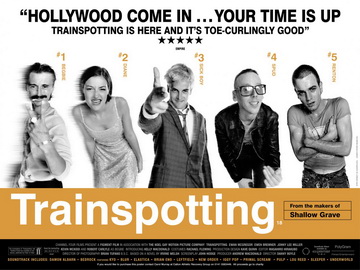
Trainspotting

Image result for trainspotting film

In the film opening transporting the main character is seemed to be rushed and slightly angry. The use of swear words are constantly used through out the clip maybe defining either the area that he is from or the background that he has been brought up in order to respond or talk to people, including the cameras audience, in that way. A lot of the culture is shown in the way that the language is used with swearing, and fact there is a lot of smoking in multiple parts of the scene, not only from one character but a few and the use of their nick names being put up when they are introduced at the beginning in the freeze frames when each of the main characters are used. The character again, is shown to be rushed, as nearer the beginning of the film he is very nearly hit y a car as he does not slow down or look either way as if he was quickly needing to get somewhere. The next scene shows him and his friends at football. The freeze frames are used to slow down the camera and show clearly each of the different characters faces so that the audience is well introduced to them and can recognise them through the rest of the film. Bernie, Tommy, Spud are just a few of the name that the boys have been given from one another, showing that they are not their actual names but that they all have close relationships to call each other something other than their name.


Overall all three of the different film opening has similarities and differences between them. All three of them has a bit of narrative which, although you couldn't tell what the main storyline was about you were able to make out what was going on or going to happen nearer the beginning of the film. All three of the films had a different approach mainly because between them they had very different themes due to the different genres they had been produced in.

Conventions of a film opening

Rules of the credit sequence


In a film of television program or video, the credits help to list some of the most important people behind the making of the production. When shown at the beginning of a film, the credits are normally text that appear on the screen whilst the beginning of the film is taking place. Although sometimes they are shown with static pictures they also could be shown on blank screens in order to add emphasis dependant on whether there is a point that needs to be made or got across to the audience.
Music could also be added to the background of the credit sequence to portray the mood and the atmosphere of what is going to take place or what is happening at the time through either parallel or contrapuntal sound.


A films credit sequence
A TV programs credit sequence
-           They are normally longer and prolonged as they have the time to be more spread out and spaced evenly with the opening scene of a film.
-           Normally show in front of the films locale.
-           Sequence is elaborate and is one of the first things the audience see.
-           Tell who’s in the movie and what’s about to come.
-           The film Tin Tin shows at the beginning of the film, it jumps straight into the credits.
Examples:
 
 
-           They normally are shorter, more to the point
-           Show small clips of some events that may happen in the later series.
-           They are normally more memorable e.g. the music theme tune
-           Each episode starts differently but credits come in about 5 minutes later.
-           American horror story’s openings  consist
Examples:
Orange is the new Black